Gosi Registration Process in Saudi Arabia

How to Register for GOSI in Saudi Arabia: A Step-by-Step Tutorial GOSI registration in Saudi Arabia is a mandatory process for any business hiring employees within the Kingdom. Companies must register with the General Organization for Social Insurance (GOSI) to manage social insurance contributions, comply with Saudi Labor Law, and access critical government platforms like Qiwa and Muqeem. Failing to register can lead to heavy fines and the suspension of government services. What is GOSI in Saudi Arabia? The General Organization for Social Insurance (GOSI) is a semi-government entity responsible for implementing social insurance rules across Saudi Arabia. Think of it as the backbone of the Saudi social security system. The primary purpose of GOSI is to provide a safety net for employees. It collects contributions from both employers and employees to fund benefits related to retirement, occupational hazards, and unemployment (SANED). Under the Saudi Labor Law, every establishment that employs at least one person must open a GOSI account. Why is it Mandatory? GOSI isn’t just a “good-to-have” insurance; it is a legal prerequisite for business operations. It is digitally linked to the Ministry of Human Resources and Social Development (MHRSD). If your GOSI record is not active or compliant, you cannot renew work permits or issue new visas. Who Must Register with GOSI? A common misconception is that GOSI only applies to large corporations. In reality, the scope is much broader: Local LLCs & Joint Stock Companies: All Saudi-owned entities. Foreign Companies: International firms with MISA licenses and branch offices operating in the Kingdom. Startups & SMEs: Even if you have only one Saudi or expat employee. Governmental & Semi-Governmental Bodies: Public sector entities. Individual Establishments: Small businesses owned by individuals. Pro Tip: Foreign investors often overlook that even if they haven’t hired their first employee yet, the General Manager or the person listed on the Commercial Registration (CR) often needs to be accounted for in the system to maintain “Green” status in Nitaqat. Benefits of GOSI Registration for Employers While it is a legal obligation, GOSI offers significant operational advantages: Legal Compliance: Avoids the “Red” zone in the Nitaqat (Saudization) system. Visa Processing: You cannot issue or renew Iqamas (residency permits) without a valid GOSI record. Government Tenders: To bid for government contracts, a “GOSI Certificate” is a mandatory document. Employee Retention: It provides workers with occupational hazard insurance, covering medical costs for work-related injuries. Integration: Seamlessly connects with Qiwa (for contract management) and Mudad (for Wage Protection System compliance). Documents Required for GOSI Registration Before starting the online process on the GOSI portal, ensure you have the following digital copies ready: Document Requirement Level Purpose Commercial Registration (CR) Mandatory To verify the legal existence of the business. National Address Mandatory To link the establishment to a physical location. Owner/Manager ID (Iqama/Saudi ID) Mandatory To verify the authorized person. Entity Stamp Recommended For authenticating certain offline requests if needed. MISA License For Foreign Firms To prove the foreign investment status. Step-by-Step GOSI Registration Process (2026) The GOSI portal has become highly automated. In many cases, once a CR is issued, a GOSI account is automatically drafted. However, you must still complete the setup. Step 1: Access the GOSI Portal Visit the official GOSI website and select “Business” login. Use your Nafath (National Single Sign-On) credentials for secure access. Step 2: Register the Establishment If your company isn’t automatically listed, click on “Register Establishment.” You will need to input your CR number and the city of operation. Step 3: Add Branch Information If your business has branches in Riyadh, Jeddah, or Dammam, ensure each is registered under the main account. This is vital for regional labor office compliance. Step 4: Register Employees This is the most critical step. You must add: Saudi Employees: Using their National ID. Expatriate Employees: Using their Iqama number or Border Number. Step 5: Define Salary and Benefits Enter the Basic Salary + Housing Allowance. These two components form the “Contribution Account Salary.” Ensure these figures match the contracts uploaded on Qiwa. Step 6: Verify and Submit Once submitted, GOSI will review the application. Upon approval, you will receive your Establishment Number, which is used for all future insurance transactions. GOSI Contribution Rates (2026 Update) Contributions are calculated as a percentage of the employee’s total fixed salary (Basic + Housing). Contribution Category Employer Share Employee Share Total Applicable To Annuities (Pension) 9% 9% 18% Saudi Nationals only SANED (Unemployment) 0.75% 0.75% 1.5% Saudi Nationals only Occupational Hazard 2% 0% 2% All Employees Example of GOSI Calculation If a Saudi employee earns a total salary of SAR 10,000: Employer pays: SAR 900 (Annuity) + SAR 75 (SANED) + SAR 200 (Hazard) = SAR 1,175 Employee pays: SAR 900 (Annuity) + SAR 75 (SANED) = SAR 975 (Deducted from salary) Total Monthly GOSI Payment: SAR 2,150 For a Non-Saudi employee earning SAR 10,000: Employer pays: SAR 200 (Occupational Hazard only). Employee pays: SAR 0. How to Download the GOSI Certificate The GOSI Certificate is the document that proves your company is compliant. You will need it for renewing your CR, applying for visas, or opening corporate bank accounts. Log in to the GOSI Business portal. Navigate to the “Certificates” or “Reports” Select “Establishment Compliance Certificate.” Download the PDF. The certificate is usually valid for 3 months and contains a QR code for verification by third parties. GOSI, Qiwa, and Mudad: Understanding the Ecosystem A common mistake for new businesses is treating GOSI as an isolated platform. In the 2026 Saudi business environment, these three platforms talk to each other: Qiwa: Where you sign the digital employment contract. GOSI: Where you register the employee for insurance based on that contract. Mudad: The platform used to pay salaries. If the salary paid in Mudad doesn’t match the salary registered in GOSI, you will trigger a Wage Protection System (WPS) violation. Common GOSI Registration Mistakes to Avoid Through our experience at Jadir, we see companies face penalties for these easily avoidable errors: Delayed Registration: New employees must be
Company Registration in Saudi Arabia for Foreigners With Full Guide

Company Registration in Saudi Arabia for Foreigners With Full Guide If you are looking to expand your business horizons, there is arguably no more exciting destination in 2026 than the Kingdom of Saudi Arabia (KSA). Driven by the ambitious Vision 2030, the Kingdom has transformed from an oil-dependent giant into a diversified, tech-forward global hub. For foreign entrepreneurs, the message is clear: the doors are wide open. Dreaming of Starting a Business in Saudi Arabia? Starting a business in a foreign country, especially one with a unique legal and cultural framework like Saudi Arabia, can feel overwhelming. You might be concerned about “red tape,” finding a local partner, or navigating complex tax laws. Here is the good news: the process has never been faster or more transparent. In 2026, the Saudi government has streamlined digital portals, removed many ownership barriers, and introduced “investor-first” policies. Whether you are a tech startup from India, a consultancy from Europe, or a trading firm from the US, Saudi Arabia is actively courting your expertise. Why Saudi Arabia is a Smart Choice for Foreign Businesses Saudi Arabia is no longer just about oil. It is a market of over 36 million people with high purchasing power and a government investing trillions into “Giga-projects” like NEOM, Qiddiya, and The Red Sea Project. Top Reasons to Invest: Strategic Location: KSA sits at the crossroads of three continents (Asia, Africa, and Europe), making it a prime logistics hub. 100% Ownership: In most sectors, you no longer need a Saudi national partner to own your business. Digital Governance: Systems like MISA, Qiwa, and Mudad have digitized almost 90% of the bureaucratic process. Safety and Stability: KSA offers one of the most stable economic environments in the MENA region. High-Growth Sectors in 2026: Technology & AI: Massive demand for software development and cybersecurity. Renewable Energy: Focus on solar and green hydrogen. Tourism & Hospitality: Following the boom in Jeddah and Riyadh’s entertainment seasons. E-commerce & Logistics: A rapidly growing young, tech-savvy population. Can Foreigners Own 100% of a Company in Saudi Arabia? A common myth is that you need a “Local Sponsor” who owns 51% of your company. This is largely outdated. Under the Ministry of Investment (MISA), foreign investors can enjoy 100% ownership in a wide range of activities. Allowed Sectors for 100% Ownership: Consulting & Professional Services (Management, IT, Engineering). Manufacturing (Industrial licenses). Wholesale and Retail Trading (Subject to specific capital requirements). Information Technology and Software Development. Restricted Areas: There are still a few sectors reserved for Saudi nationals or restricted for security reasons: Oil exploration and production. Military and defense-related services. Real estate investment in the holy cities of Makkah and Madinah. Certain recruitment services. Business Structure Comparison (Easy Table) Choosing the right legal entity is the foundation of your success. Most foreign investors opt for a Limited Liability Company (LLC) due to its flexibility. Business Type Best For Benefits Risk/Requirement LLC Small to medium businesses/Startups 100% ownership, limited liability Moderate compliance, audit requirements Branch Office Existing foreign companies Fast setup, no minimum capital for some Parent company takes full liability Regional HQ (RHQ) Multinational Corporations 0% Corporate Tax for 30 years Must manage 2+ countries from KSA Professional LLC Licensed professionals (Architects, Doctors) Direct ownership of service delivery Requires specific professional degrees Pro Tip: For 90% of entrepreneurs entering the market for the first time, the Limited Liability Company (LLC) is the safest and most efficient choice. Step-by-Step Company Registration Process In 2026, the registration process is categorized into “Pre-Registration” and “Post-Registration.” Here is the step-by-step roadmap. Step 1: Get Your MISA Investment License The Ministry of Investment (MISA) is the gatekeeper. You cannot register with the Ministry of Commerce until MISA approves your investment. Documents Needed: Passport copies, parent company financial statements (if applicable), and a basic business plan. Time: 3–7 business days. Step 2: Reserve Your Company Name You must choose a name that isn’t already taken and complies with Saudi sensitivities. It must be translated into Arabic for the official registry. Time: 1–2 days. Step 3: Prepare the Articles of Association (AoA) This is your company’s “constitution.” It defines who owns what, how the company is managed, and what activities it will perform. In 2026, this is mostly done through an electronic portal. Requirement: Must be in Arabic (or bilingual). Time: 2–3 days. Step 4: Issue the Commercial Registration (CR) Once the AoA is signed (digitally or at a notary), the Ministry of Commerce issues your Commercial Registration (CR). This is your company’s birth certificate and official ID number. Time: 1–3 days. Step 5: Chamber of Commerce & National Address You must register with the local Chamber of Commerce (e.g., Riyadh or Jeddah) and establish a “National Address.” This requires a physical or virtual office lease. Step 6: Open a Corporate Bank Account This is often the step that takes the longest. Saudi banks have strict “Know Your Customer” (KYC) rules. Requirement: The General Manager usually needs to be physically present in the Kingdom. Time: 1–2 weeks. What to Do After Company Registration Obtaining your CR is only the halfway point. To hire staff and stay legal, you must complete the “Compliance Chain.” ZATCA Registration: Register with the Zakat, Tax and Customs Authority. In 2026, E-Invoicing (Fatoora) is mandatory for all businesses. GOSI Registration: The General Organization for Social Insurance. This is where you register employees (both Saudi and foreign) for social security. Qiwa & Mudad: These platforms handle your labor contracts and salary transfers (Wage Protection System). Saudization (Nitaqat): You must understand your “quota.” Depending on your industry, you may be required to hire a certain percentage of Saudi nationals. Company Registration Cost in Saudi Arabia (2026 Estimates) While costs vary based on your activity, here is a realistic breakdown in Saudi Riyals (SAR): Item Estimated Cost (SAR) MISA License (Annual) SAR 2,000 – 12,000 (Varies by category) Commercial Registration (CR) SAR 1,200 Chamber of Commerce Fee SAR 2,000 – 5,000 Municipality (Baladiya) License SAR 1,000 – 5,000 Office Rent (Shared/Small)
Company Formation Saudi Arabia Complete Pro Guide
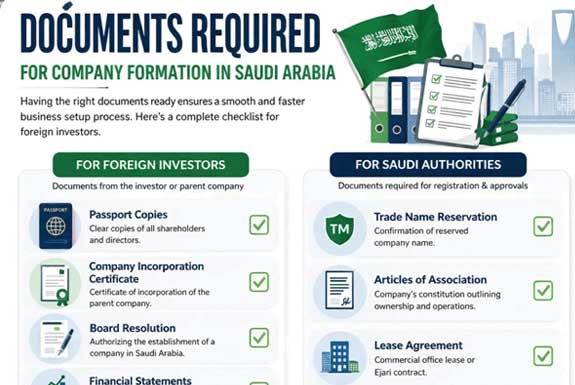
Complete Guide to Company Formation in Saudi Arabia (2026) Saudi Arabia is emerging as a global investment hub under Vision 2030, offering unmatched opportunities for entrepreneurs and foreign investors. From simplified regulations to 100% foreign ownership in many sectors, the country provides a strong foundation for business growth.In this guide, you’ll learn everything about business setup in Saudi Arabia, including legal structures, costs, step-by-step process, and compliance requirements. Why Foreign Investors Choose Saudi Arabia Saudi Arabia has positioned itself as a strategic destination for global investors through economic diversification and business-friendly reforms. Its location connects major global markets, making it ideal for international trade and expansion. With initiatives under Vision 2030, the government is actively supporting foreign investments by simplifying regulations and offering incentives. These developments make business setup in Saudi Arabia more accessible and profitable than ever. Key Reasons to Invest Strategic location connecting Asia, Europe, and Africa Vision 2030 initiatives boosting private sector growth 100% foreign ownership in multiple sectors Large consumer market with high spending power Economic Growth Factors Expansion in tech, tourism, and logistics Government mega projects like NEOM Increasing foreign direct investment (FDI) Benefits of Setting Up a Company in Saudi Arabia Setting up a business in Saudi Arabia provides both financial and operational advantages for investors. Companies benefit from a stable economy, strong legal framework, and access to the GCC market. Additionally, the availability of digital government platforms and streamlined processes makes business operations efficient. These benefits make Saudi Arabia an ideal destination for long-term business growth and expansion. Business Benefits Full ownership for foreign investors Access to GCC markets Stable economy and currency Operational Benefits Digital portals like Qiwa & Absher Easy employee visa processing Strong regulatory framework Financial Benefits Competitive tax system VAT aligned with global standards Government incentives for investors Types of Company Setup for Foreign Investors Foreign investors can choose from various business structures depending on their operational needs and investment goals. The most common options include LLCs, branch offices, and joint ventures.Each type offers different levels of ownership, liability, and flexibility. Selecting the right structure is essential to ensure compliance with Saudi regulations and to maximize business efficiency. Common Company Types Limited Liability Company (LLC) – Flexible and most popular Branch Office – Extension of a foreign company Representative Office – Market research only Joint Venture – Partnership with Saudi entity Each structure offers different benefits based on ownership, liability, and operations. Types of Legal Structures in Saudi Arabia Choosing the right legal structure is critical for compliance and long-term growth. Available Structures Limited Liability Company (LLC) Joint Stock Company (JSC) Branch of Foreign Company Sole Establishment Holding Company Key Considerations Ownership rules Capital requirements Industry regulations Investment Sectors for Foreigners Saudi Arabia allows foreign investment across high-growth industries. Top Sectors Technology & IT E-commerce Healthcare Tourism & Hospitality Construction & Real Estate Some sectors may require special approvals depending on regulations. Step-by-Step Company Formation Process This is the core process for starting a business in Saudi Arabia. Step-by-Step Guide Define business activity and eligibility Apply for MISA license Reserve company name Draft Articles of Association Obtain Commercial Registration (CR) Register with ZATCA, GOSI, Chamber Open corporate bank account Get business licenses Hire employees and process visas This process typically takes 4–8 weeks, depending on approvals. Documents Required for Company Formation Proper documentation is essential for successful company formation in Saudi Arabia. Foreign investors must provide key documents such as passport copies, financial records, and company incorporation certificates.Additionally, local authorities require documents like trade name registration and lease agreements. Ensuring all documents are accurate and complete helps speed up approvals and reduces complications. For Foreign Investors Passport copies Parent company documents Board resolution Financial statements Power of attorney For Authorities Trade name reservation Articles of Association Office lease agreement Bank certificate Role of MISA in Company Formation The Ministry of Investment (MISA) plays a vital role in regulating foreign investments in Saudi Arabia. It is responsible for issuing licenses and approving business activities for foreign companies.Obtaining a MISA license is mandatory for foreign investors to legally operate in the country. It also provides access to various business opportunities and government support. Key Functions Approves foreign investment Issues licenses Enables 100% ownership A MISA license is mandatory for foreign investors to operate legally. Compliance Requirements After Setup After company formation, businesses must comply with regulations. Key Compliance Areas VAT registration (15%) Zakat & corporate tax Saudization (Nitaqat program) Labor law compliance Failure to comply may lead to penalties. Cost of Company Formation in Saudi Arabia Understanding cost helps in planning your investment. Estimated Costs Small Business: SAR 15,000 – 30,000 Medium Business: SAR 30,000 – 80,000 Large Investment: SAR 100,000+ Cost Includes MISA license CR registration Office rent Legal & PRO services Tax System in Saudi Arabia Saudi Arabia follows a structured tax system that includes corporate tax, VAT, and Zakat. Foreign investors are generally subject to corporate tax, while VAT applies to most goods and services.Compliance with tax regulations is crucial to avoid penalties and ensure smooth operations. Maintaining proper accounting records and timely filings is highly recommended.Saudi Arabia follows a structured tax system. Key Taxes Corporate Tax: 20% (foreign investors) Zakat: 2.5% (Saudi owners) VAT: 15% Important Notes Mandatory VAT registration Regular filing required Penalties for delays Saudization (Nitaqat Program) Saudization ensures employment of Saudi nationals. Key Points Companies must hire local employees Classified into Platinum, Green, Yellow, Red Impacts visa approvals Maintaining compliance is crucial for smooth operations. Comparison of Legal Structures Feature LLC Branch Joint Venture Ownership Flexible 100% Foreign Shared Liability Limited Parent Shared Complexity Medium Low High 👉 LLC is the best choice for most businesses. Common Mistakes to Avoid Choosing wrong legal structure Ignoring Saudization rules Delaying VAT registration Incorrect documentation Avoiding these mistakes can save time and cost. Timeline for Business Setup Step Time MISA License 1–3 weeks CR Registration 3–5 days Full Setup 4–8 weeks Government Authorities Involved Ministry of Investment (MISA) Ministry of Commerce ZATCA GOSI MHRSD These authorities