Complete Guide to Company Formation in Saudi Arabia (2026)
Saudi Arabia is emerging as a global investment hub under Vision 2030, offering unmatched opportunities for entrepreneurs and foreign investors. From simplified regulations to 100% foreign ownership in many sectors, the country provides a strong foundation for business growth.
In this guide, you’ll learn everything about business setup in Saudi Arabia, including legal structures, costs, step-by-step process, and compliance requirements.

Why Foreign Investors Choose Saudi Arabia
Saudi Arabia has positioned itself as a strategic destination for global investors through economic diversification and business-friendly reforms. Its location connects major global markets, making it ideal for international trade and expansion.
With initiatives under Vision 2030, the government is actively supporting foreign investments by simplifying regulations and offering incentives. These developments make business setup in Saudi Arabia more accessible and profitable than ever.
Key Reasons to Invest
- Strategic location connecting Asia, Europe, and Africa
- Vision 2030 initiatives boosting private sector growth
- 100% foreign ownership in multiple sectors
- Large consumer market with high spending power
Economic Growth Factors
- Expansion in tech, tourism, and logistics
- Government mega projects like NEOM
- Increasing foreign direct investment (FDI)
Benefits of Setting Up a Company in Saudi Arabia
Setting up a business in Saudi Arabia provides both financial and operational advantages for investors. Companies benefit from a stable economy, strong legal framework, and access to the GCC market.
Additionally, the availability of digital government platforms and streamlined processes makes business operations efficient. These benefits make Saudi Arabia an ideal destination for long-term business growth and expansion.
Business Benefits
- Full ownership for foreign investors
- Access to GCC markets
- Stable economy and currency
Operational Benefits
- Digital portals like Qiwa & Absher
- Easy employee visa processing
- Strong regulatory framework
Financial Benefits
- Competitive tax system
- VAT aligned with global standards
- Government incentives for investors
Types of Company Setup for Foreign Investors
Foreign investors can choose from various business structures depending on their operational needs and investment goals. The most common options include LLCs, branch offices, and joint ventures.
Each type offers different levels of ownership, liability, and flexibility. Selecting the right structure is essential to ensure compliance with Saudi regulations and to maximize business efficiency.
Common Company Types
- Limited Liability Company (LLC) – Flexible and most popular
- Branch Office – Extension of a foreign company
- Representative Office – Market research only
- Joint Venture – Partnership with Saudi entity
Each structure offers different benefits based on ownership, liability, and operations.
Types of Legal Structures in Saudi Arabia
Choosing the right legal structure is critical for compliance and long-term growth.
Available Structures
- Limited Liability Company (LLC)
- Joint Stock Company (JSC)
- Branch of Foreign Company
- Sole Establishment
- Holding Company
Key Considerations
- Ownership rules
- Capital requirements
- Industry regulations
Investment Sectors for Foreigners
Saudi Arabia allows foreign investment across high-growth industries.
Top Sectors
- Technology & IT
- E-commerce
- Healthcare
- Tourism & Hospitality
- Construction & Real Estate
Some sectors may require special approvals depending on regulations.
Step-by-Step Company Formation Process
This is the core process for starting a business in Saudi Arabia.
Step-by-Step Guide
- Define business activity and eligibility
- Apply for MISA license
- Reserve company name
- Draft Articles of Association
- Obtain Commercial Registration (CR)
- Register with ZATCA, GOSI, Chamber
- Open corporate bank account
- Get business licenses
- Hire employees and process visas
This process typically takes 4–8 weeks, depending on approvals.
Documents Required for Company Formation
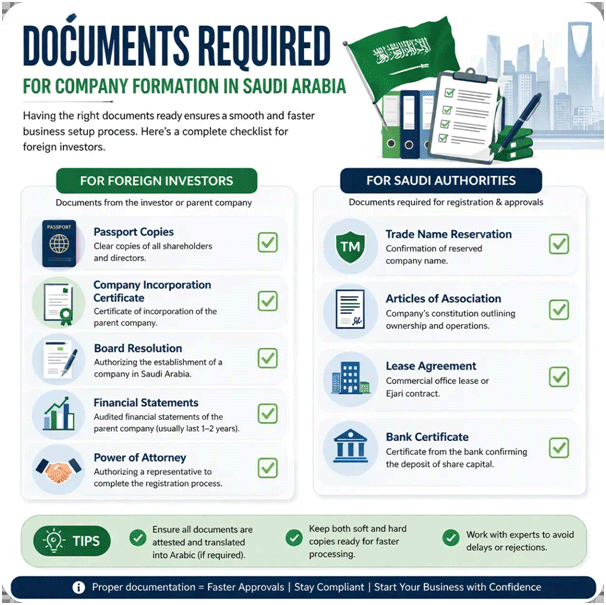
Proper documentation is essential for successful company formation in Saudi Arabia. Foreign investors must provide key documents such as passport copies, financial records, and company incorporation certificates.
Additionally, local authorities require documents like trade name registration and lease agreements. Ensuring all documents are accurate and complete helps speed up approvals and reduces complications.
For Foreign Investors
- Passport copies
- Parent company documents
- Board resolution
- Financial statements
- Power of attorney
For Authorities
- Trade name reservation
- Articles of Association
- Office lease agreement
- Bank certificate
Role of MISA in Company Formation
The Ministry of Investment (MISA) plays a vital role in regulating foreign investments in Saudi Arabia. It is responsible for issuing licenses and approving business activities for foreign companies.
Obtaining a MISA license is mandatory for foreign investors to legally operate in the country. It also provides access to various business opportunities and government support.
Key Functions
- Approves foreign investment
- Issues licenses
- Enables 100% ownership
A MISA license is mandatory for foreign investors to operate legally.
Compliance Requirements After Setup
After company formation, businesses must comply with regulations.
Key Compliance Areas
- VAT registration (15%)
- Zakat & corporate tax
- Saudization (Nitaqat program)
- Labor law compliance
Failure to comply may lead to penalties.
Cost of Company Formation in Saudi Arabia
Understanding cost helps in planning your investment.
Estimated Costs
- Small Business: SAR 15,000 – 30,000
- Medium Business: SAR 30,000 – 80,000
- Large Investment: SAR 100,000+
Cost Includes
- MISA license
- CR registration
- Office rent
- Legal & PRO services
Tax System in Saudi Arabia
Saudi Arabia follows a structured tax system that includes corporate tax, VAT, and Zakat. Foreign investors are generally subject to corporate tax, while VAT applies to most goods and services.
Compliance with tax regulations is crucial to avoid penalties and ensure smooth operations. Maintaining proper accounting records and timely filings is highly recommended.
Saudi Arabia follows a structured tax system.
Key Taxes
- Corporate Tax: 20% (foreign investors)
- Zakat: 2.5% (Saudi owners)
- VAT: 15%
Important Notes
- Mandatory VAT registration
- Regular filing required
- Penalties for delays
Saudization (Nitaqat Program)
Saudization ensures employment of Saudi nationals.
Key Points
- Companies must hire local employees
- Classified into Platinum, Green, Yellow, Red
- Impacts visa approvals
Maintaining compliance is crucial for smooth operations.
Comparison of Legal Structures
Feature | LLC | Branch | Joint Venture |
Ownership | Flexible | 100% Foreign | Shared |
Liability | Limited | Parent | Shared |
Complexity | Medium | Low | High |
👉 LLC is the best choice for most businesses.
Common Mistakes to Avoid
- Choosing wrong legal structure
- Ignoring Saudization rules
- Delaying VAT registration
- Incorrect documentation
Avoiding these mistakes can save time and cost.
Timeline for Business Setup
Step | Time |
MISA License | 1–3 weeks |
CR Registration | 3–5 days |
Full Setup | 4–8 weeks |
Government Authorities Involved
- Ministry of Investment (MISA)
- Ministry of Commerce
- ZATCA
- GOSI
- MHRSD
These authorities regulate business operations and compliance.
Why Saudi Arabia is the Future of Business
Saudi Arabia is transforming into a global business powerhouse with strong government support and economic diversification. Mega projects and digital transformation are creating new opportunities for investors.
With increasing foreign investment and a growing economy, the country offers long-term growth potential. Businesses entering now can benefit from early market opportunities.
Key Drivers
- Vision 2030 reforms
- Mega projects like NEOM
- Digital economy growth
Why Choose Professional Consultants
Professional consultants help simplify the company formation process by handling documentation, approvals, and compliance. Their expertise reduces risks and ensures a faster setup.
Working with experts allows businesses to focus on growth while ensuring all legal requirements are met. This results in a smoother and more efficient business setup experience.
Benefits
- Faster approvals
- Complete compliance
- Reduced risk
- Expert guidance
Conclusion
Company formation in Saudi Arabia offers significant opportunities for investors worldwide. With the right strategy, legal compliance, and professional support, businesses can establish and scale successfully in this growing market.